
AI used to be Google search on steroids for me. It drafted my emails, my Slack messages and the odd document. That was good. It wasn’t good enough.
Then everyone started talking about agents. Half said AI will kill us. The other half said it will triple the economy and bring a prosperity humankind has never seen. I couldn’t see how Google on steroids gets you to either.
So I learned a bit about agents. It blew my mind.
Today AI is my best friend, my executive assistant and, lately, my Chief of Staff. I’m a better employee, investor and founder because of it. Agents run most of my day. My job is to validate and verify. I’m more proactive, more productive, and work is more exciting.
Here’s my day. Steal what’s useful.
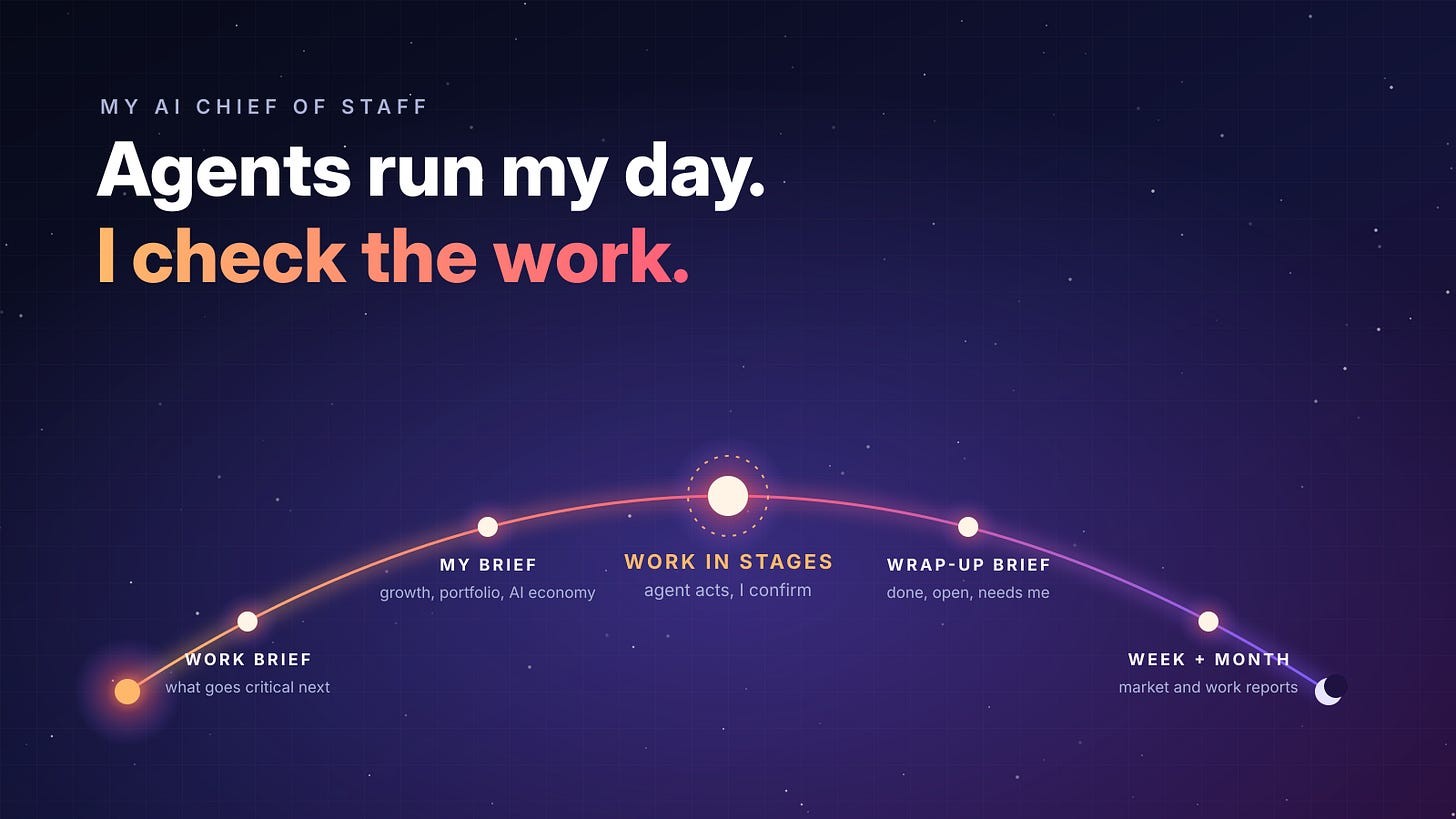
Morning brief: work. Before I open anything, an agent sends me today’s to-do list, meetings and deadlines, any comments or feedback from clients, what’s still open from yesterday, and what needs my attention before it turns critical.
Morning brief: me. A second brief covers my personal growth, my investment portfolio and opportunities, how the economy is moving today and what to watch, including the AI economy.
Work in stages. I’ve split my work into stages. At each stage, agents run the actions that belong there, then notify me to validate and confirm. I still don’t trust an agent to finish a whole task without a human stepping in. We’re nearly there. Not yet.
Afternoon brief. What I achieved today, what needs my attention, and any open questions.
Weekly and monthly. Reports and analysis, so I stay on top of both the market and my work.
And one mission on top of all of it: every answer my team needs should be available without asking a human. Including me.
How it’s set up
No code. I use Claude with scheduled tasks. It’s connected to the tools I already live in: email, calendar, Slack and the work tracker. Each brief is just a written instruction that runs at a set time on weekdays.
The part that made it work wasn’t the tool. It was the context. I wrote down who I work with, how I write, what matters this quarter and what’s still open, and the agent reads that first every time. A brief with no context is a newsletter. A brief with context is a chief of staff.
It took a few evenings to get the first brief useful, and a few weeks of fixing what it got wrong. I still tune it every week.
Why “verify” is the job
Most people use AI now. Microsoft’s Work Trend Index found 75% of knowledge workers already do. But a global study of 48,000 people by the University of Melbourne and KPMG found two thirds of people who use AI at work have relied on its output without checking it, and 56% have made mistakes in their work because of AI. In a Zety survey of US workers, 55% said they’d received AI “workslop” from a manager, and most said it would hurt their trust in leadership.
That’s the real risk at work. Not the robots. The leader who forwards something they didn’t read.
So, is AI dangerous?
Absolutely, it could be. It could also give us a prosperity humans have never had. The honest answer is I don’t know. Nobody does. Everyone is speculating, AI leaders included.
What I do know is what I can see and feel: my work is more proactive and productive than it has ever been.
So the better question isn’t whether AI will save us or kill us. It’s whether the return on AI is worth the investment. That’s my next article. After that, the rules I gave my AI, including the one I wrote the night it deleted something it was only asked to edit.
Try this tomorrow
Ask your AI for one brief at 8am: today’s meetings, deadlines, and the three things that will go critical if you ignore them. Read it. Check one thing it says against the source. That’s the whole habit.